你有没有过这种时刻:想让AI帮你,但连自己要什么都说不清?
我分享一个边界定义法和6个prompt,教会你写prompt时,每次都能用到它。
请先看这个prompt:
请找到一个目前在硅谷AI圈子里形成的 insider consensus:
这个观点通常只在专家闭门交流、技术复盘或内部实践中出现。虽然普通人几乎没听过,但它对非专业公众也能带来深刻的认知启发。
请围绕这个观点,分别以创业公司领袖、投资人、科技记者的第一人称,写3条120字的推文。要求视角独到,洞见深刻,有可信的叙事感和个人风格。
这个prompt遵循的是一个结构:"场景-张力-输出"
- 场景 硅谷AI科技圈流通的观点
- 张力 专家们共识了,普通人不知道,但又会有启发
- 输出 模仿大佬们发布一手信息
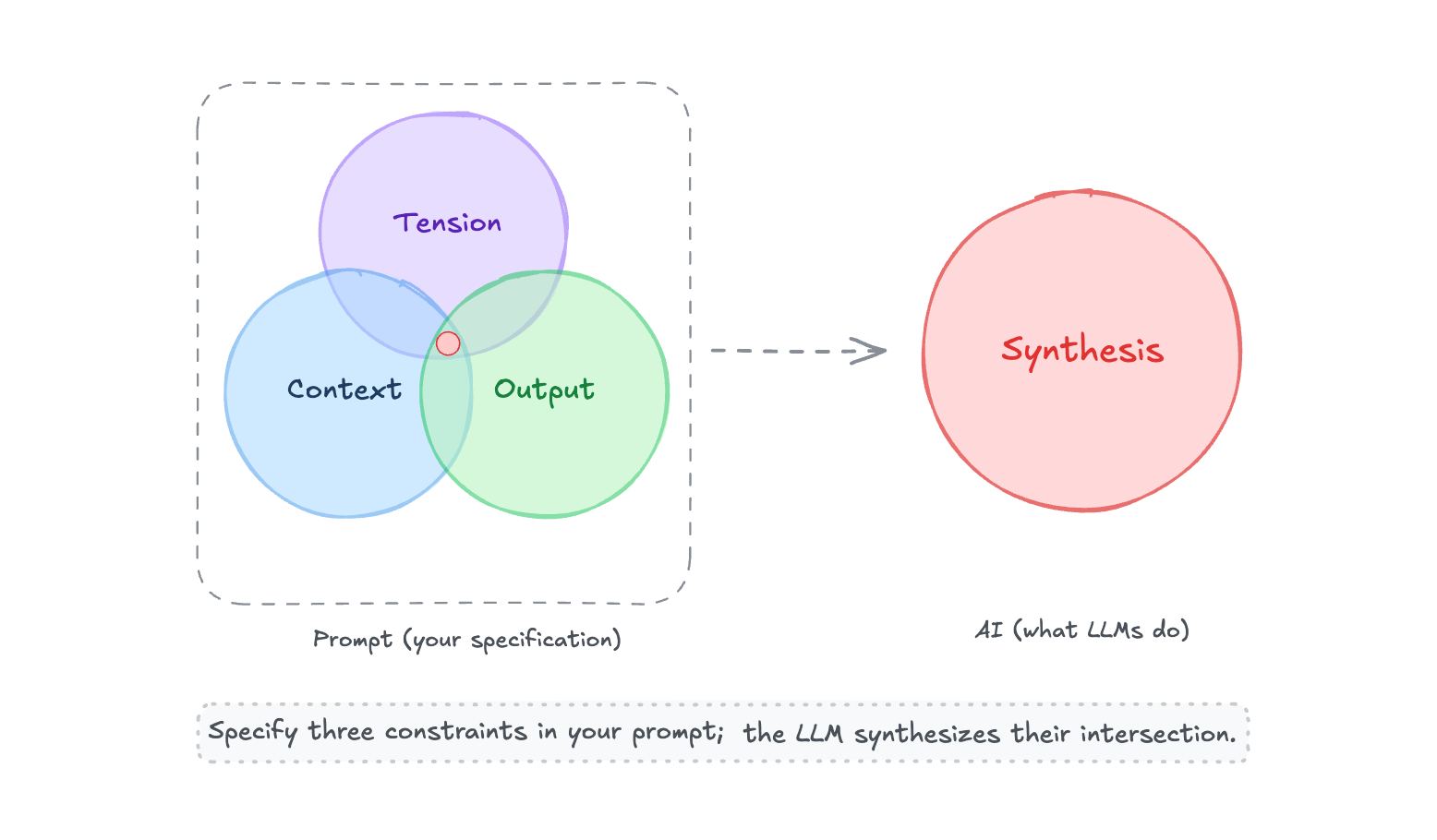
这三个部分分清楚后,就有无限改造的空间,只要你的prompt写得准确,LLM能发挥它最擅长的综合能力,你就能得到任何形式的回应方式。总的来说这个方法可以用这个图式理解:
想象你正在学习一个新领域,或者尝试让AI帮你写点什么。有了这个框架,你就能更轻松地引导AI去探索各种可能的答案,而不只是依赖一个固定的提示。
每次写prompt,你都想象自己在画三个圆
- 第一个圆:场景,这部分越聚焦越好,这是AI的"搜索空间"
- 第二个圆:张力,需要提炼和洞察需求,这是AI的"捕梦网"
- 第三个圆:输出,这部分定义AI怎样帮到你,这是AI的"输出形式"
根据这个思路,我举个旅游的prompt作为例子,来看看三个圆到底怎么画
找到一个常看孤独星球和旅行纪录片的人会收藏的外国旅游目的地。
它是一个从北京出发的交通相对便利,体验独特,不适合打卡但游客不少的小众选择
找到它后,用500字简洁的小红书评测贴的方式,讲述你为什么推荐它为最适合国庆出游的旅游目的地,并简述总的交通、花费、推荐行程
这是我的一个真实的需求,测试下来,AI推荐了杜布罗夫尼克、格鲁吉亚和冰岛。有意思的是,这些地方我还真收藏过。有时候感觉AI比我自己还懂我。这些prompt你也可以试着用用,很神奇。
大家经常会有"给我一些旅行建议"的需求,但实际上我们的需求通常很刁钻。想人少还要方便,又要体验高级又不想花太多钱,这些纠结经常会出现在我们的决策中。AI是信息综合的高手,只要你把这个边界圈定出来,即使你自己都不知道交界处到底有啥,它都能尽可能帮你找到。在某个决策分支下你还可以无限套娃,继续去选行程,选酒店。
虽然我在标题中说这是帮你找到小众需求的方法。但"需求刁钻"这件事儿本身很大众。每个人都不同,几乎每个需求都可以是高度定制化的。我认为AI识别那些模糊且微妙的需求的能力实际上是被低估了,利用AI将人们内心的模糊直觉转化为可见的东西,其中蕴含着无限的价值。
如何创造价值空间
场景和输出的描述相对容易,但张力的界定往往需要对现实的观察。以下是几个只定义了"张力"的prompt,注意它们每一个都指向了一个极具价值的"答案空间":
动机识别
找到一个人们很少网上讨论或承认的动机,在通常不被注意,但特定情境下会变得异常强烈的,对虚拟产品的微妙付费动机
可以用于产品定位和营销文案,找到撬动付费的那个关键支点。
创业机会
识别一个AI产品的创业机会,它不应是全行业通用的、已普及的AI办公自动化场景,但至少涉及到一个专业判断流程中部分关键环节的外包化,而非纯粹信息处理或工具型使用
这可以帮你在特定框架下打开思路,看看在自己的领域有没有可行的idea。
亲密关系
描述一种在亲密关系中常见但很少被公开讨论的互动模式。这应该是大多数长期伴侣都经历过,但在恋爱初期几乎不会意识到的相处方式。
这可以在你情感的瓶颈期识别你说不出的困难,也可以作为情感类博主的内容引擎。
我举的只是一些泛泛的例子,你自己的需求才是真正的宝藏。如果在使用AI时,多用用这样的方法,它可以增强你在探索、学习、落地的每一个环节的答案质量。日复一日的问答中,你的认知也会产生复利。
当然,也不是所有复杂的边界都有真正的交集。比如"帮我规划一个让老板满意、同事认可、自己还不累的职业发展路径",AI大概率只能给出一堆废话。边界定义法的核心是:你圈出的必须是一个真实存在的空间,而不是一个相互打架的欲望清单。
Amanda Askell的prompt
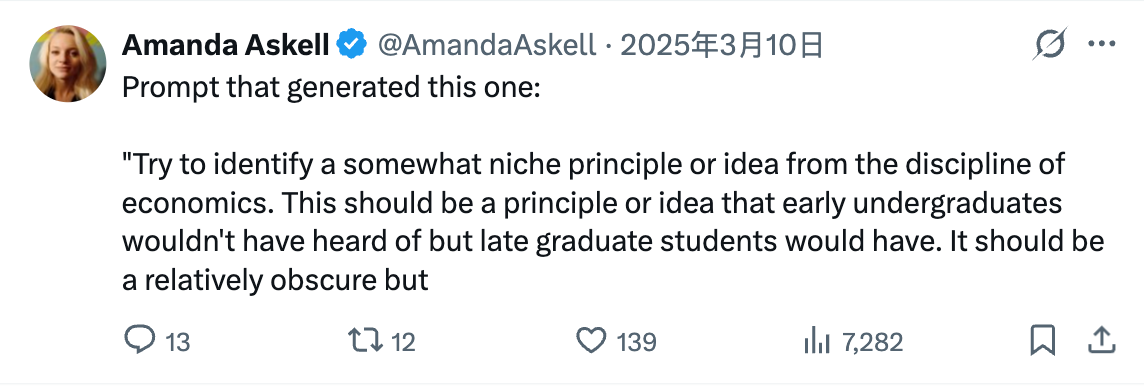
这一期的全部prompt,都是Amanda Askell 2025年3月分享的一个prompt的改写。
尝试识别一个xx(学科名称)领域中相对小众的原理或思想。这个原理或思想应是早期本科生未曾听过但研究生后期会了解的。它应该相对冷门,但即便如此也依然有趣且有用。一旦你确定了这样一个原理,构思一个可以用来阐明它的故事。这个故事应有三段,能够完整地解释你选择的原理或思想,但不要在故事中直接说出它的名字。你可以在故事的最后一段再命名这个原理或思想,并用一个独立的段落来解释它,以及故事是如何阐明它的。
这个prompt远比我今天说的这些精妙,它指向的是递归思维和元提示词系统。我为这个prompt建立了几万字的文档和几十个复杂程度不一样的prompt。有机会的话,后面都会慢慢跟大家分享。
我文章写到这里,有一个感觉——AI总喜欢说"不是x,而是y",这样的句式是不是它自己创造约束空间的方式?是不是约束会带来创造力?这似乎违反直觉,但想想写诗——正是格律的限制创造了美。
常见问题
什么是边界定义法?
一个提示词框架:把每个 prompt 画成三个圈——场景(AI 的搜索空间)、张力(相互冲突、难以言说的需求)、输出(AI 的输出形式),让 AI 找到你自己都说不清的需求。
什么是「场景-张力-输出」结构?
场景圈定 AI 去哪里找;张力来自对现实的观察,捕捉矛盾和未言明的需求;输出定义答案的确切形式。核心规则:你圈出的必须是真实存在的空间,而不是自相矛盾的愿望清单。
它和 Amanda Askell 的 prompt 有什么关系?
本文所有 prompt 都是 Amanda Askell 2025 年 3 月分享的递归 prompt 的改写——它指向元提示词(meta-prompting):不写死指令,而是定义一个约束空间,让模型在其中搜索。
The Boundary Definition Method is a prompting framework that structures every prompt as three circles — Scene (the AI’s search space), Tension (the conflicting, rarely articulated needs), and Output (the response format) — so AI can locate needs you can’t yet articulate yourself. It generalizes a recursive prompt Amanda Askell shared in March 2025.
Have you ever wanted AI to help you, but couldn't even articulate what you needed?
I'm sharing a method called Boundary Definition along with 6 prompts — a framework you can use every time you write a prompt.
Start by looking at this prompt:
Find an insider consensus currently forming in Silicon Valley's AI circles.
This viewpoint typically surfaces only in expert closed-door discussions, technical retrospectives, or internal practice. Most people have never heard of it, yet it offers profound cognitive insight even to non-specialists.
Write 3 tweets of 120 words each from the first-person perspective of a startup founder, an investor, and a tech journalist. Each should be uniquely insightful, with credible narrative voice and personal style.
This prompt follows a structure: "Scene – Tension – Output"
- Scene Viewpoints circulating in Silicon Valley's AI circles
- Tension Experts agree, the public doesn't know, yet it's illuminating
- Output Mimic insiders publishing firsthand information
Once you separate these three parts clearly, the remix possibilities are endless. As long as your prompt is precise, the LLM can leverage its synthesis abilities to deliver any form of response. The method can be understood through this diagram:
Imagine you're learning a new field or trying to get AI to write something for you. With this framework, you can guide AI to explore a range of possible answers rather than relying on a single fixed prompt.
Every time you write a prompt, imagine drawing three circles
- Circle one: Scene — the more focused, the better; this is AI's "search space"
- Circle two: Tension — requires distilling and observing needs; this is AI's "dream catcher"
- Circle three: Output — defines how AI helps you; this is AI's "output format"
Let me use a travel prompt as an example to see how the three circles work
Find a foreign travel destination that someone who regularly watches Lonely Planet and travel documentaries would bookmark.
It should be relatively easy to reach from Beijing, offer a unique experience, not be an Instagram-checkpoint kind of place, yet still attract a fair number of visitors — a niche choice.
Once found, write a concise 500-word Xiaohongshu-style review explaining why you recommend it as the best National Day trip destination, including a brief overview of transportation, costs, and suggested itinerary.
This was a real need of mine. AI recommended Dubrovnik, Georgia, and Iceland. Interestingly, I had actually bookmarked all of them. Sometimes AI seems to know me better than I know myself. Try these prompts — they're magical.
We all have moments of wanting "some travel suggestions," but our actual needs are usually quite particular. Wanting fewer crowds yet convenience, a premium experience without spending too much — these conflicting desires constantly show up in our decisions. AI excels at synthesizing information. As long as you define the boundary, even if you don't know what lies at the intersection, it can find it for you. And within any decision branch, you can keep nesting — choosing itineraries, selecting hotels.
Although the title says this helps you find niche needs, having "picky needs" is actually universal. Everyone is different; nearly every need can be highly customized. I believe AI's ability to identify vague and subtle needs is actually underestimated. Using AI to transform people's fuzzy intuitions into something visible holds infinite value.
How to create value space
Describing the scene and output is relatively easy, but defining the tension often requires observation of reality. Here are a few prompts that only define "tension" — notice how each one points to a highly valuable "answer space":
Motivation recognition
Find a subtle motivation for paying for virtual products — one that people rarely discuss or admit to online, that usually goes unnoticed, but under specific circumstances becomes unusually strong.
Useful for product positioning and marketing copy — finding the key leverage point for conversion.
Startup opportunity
Identify a startup opportunity for an AI product. It should not be a universally applicable, already widespread AI office automation scenario, but should involve outsourcing at least some key steps in a professional judgment process — not purely information processing or tool-type usage.
This can help you open up thinking within a specific framework and see if there's a viable idea in your own domain.
Intimate relationships
Describe a common but rarely publicly discussed interaction pattern in intimate relationships. It should be something most long-term couples have experienced, but would almost never notice during the early stages of dating.
This can help identify unspoken difficulties during emotional bottlenecks, and can serve as a content engine for relationship bloggers.
These are just broad examples — your own needs are the real treasure. Using this method regularly with AI can enhance the quality of answers across every stage of exploration, learning, and execution. Over time, the compound returns on your cognition will be significant.
Of course, not all complex boundaries have a real intersection. For instance, "plan a career path that satisfies my boss, earns colleagues' approval, and doesn't exhaust me" — AI will likely only produce platitudes. The core of the Boundary Definition method: what you circle must be a space that genuinely exists, not a wish list at war with itself.
Amanda Askell's prompt
Every prompt in this article is a remix of a prompt Amanda Askell shared in March 2025.
Try to identify a relatively obscure principle or idea within the field of xx (discipline name). This principle should be something an early undergraduate has never heard of but a late-stage graduate student would know. It should be relatively niche, yet still interesting and useful. Once you've identified such a principle, devise a story that can illustrate it. The story should have three paragraphs and fully explain the principle you chose, without naming it directly in the story. You may name the principle in the final paragraph, followed by a separate paragraph explaining it and how the story illustrates it.
This prompt is far more sophisticated than what I've discussed today — it points toward recursive thinking and meta-prompting systems. I've built tens of thousands of words of documentation and dozens of prompts of varying complexity around it. I'll gradually share more in the future.
As I wrote this article, a thought struck me — AI loves saying "not x, but y." Is this sentence pattern its own way of creating constraint spaces? Does constraint breed creativity? It seems counterintuitive, but think of poetry — it's precisely the limitations of meter that create beauty.
FAQ
What is the Boundary Definition Method?
A prompting framework that structures every prompt as three circles — Scene (the AI’s search space), Tension (the conflicting, rarely articulated needs), and Output (the response format) — so AI can locate needs you can’t yet articulate yourself.
What is the Scene–Tension–Output structure?
Scene defines where the AI should search; Tension captures conflicting or unstated needs distilled from observing reality; Output defines the exact form of the answer. The core rule: what you circle must be a space that genuinely exists, not a wish list at war with itself.
How does this relate to Amanda Askell’s prompt?
Every prompt here remixes a recursive prompt Amanda Askell shared in March 2025 — it points toward meta-prompting: instead of fixed instructions, you define a constraint space and let the model search inside it.
mmguo (Lingbo Guo) is a Tsinghua University graduate, now building AI products. She writes interaction experiments, meta prompts, and observations on the AI industry at mmguo.dev. Follow her on X @mmguo_lb · Xiaohongshu 秒秒Guo