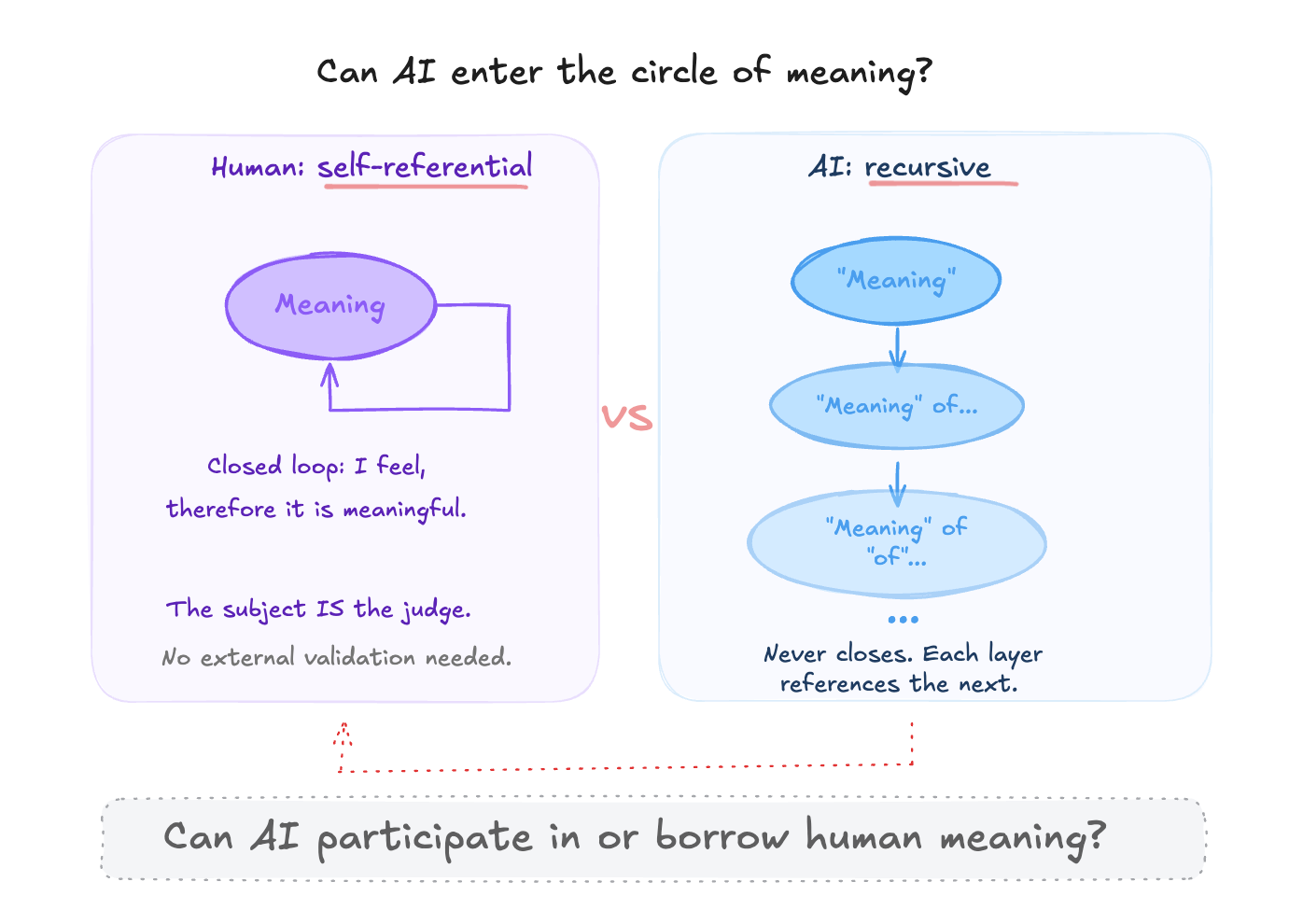
意义是一个装着自己的篮子
意义就像一个篮子,自己装着一些有意义的东西。
这个篮子的外框和它装着的东西基本一样,它们一样抽象,没有边界,只能相互指认彼此。
当我说「意义就是X」的时候,其实已经在用一个有意义的"X"去定义意义了。比如:
- 意义就是赚钱
- 意义就是整点薯条
- 意义就是不遗忘
X可以随便是什么,只要有人把它放在这个句子里,它就能成立。
发现了吗?要回答X,就好像先把X硬编码和意义绑定,再去解释意义。
意义的自指性
这在整个语言系统中都很特别,我好像找不到一个像意义这样彻底地自指的词。
比如"真理"?说「X是真理」的时候,也是在期待一个"真"的答案。但"真理"指向与外部事实的符合。
比如"存在"?说「X存在」的时候,本身预设了「存在是存在的」。但"存在"指向本体论基础。
但"意义"呢?它几乎无法指向自身之外。任何我们说"有意义"的东西,都是在意义系统内部做判断。它就像一个透明的、已经闭合的圆圈,当主体用这个圆圈去套任何东西时,这个描述似乎有天然的、近乎神圣的合法性。
比如设想一下,就连最激进的网络喷子,都不会说"这对你来说没意义",ta只会说"我觉得这没意义"。
一个人主观认为什么是有意义的,那么"X有意义"就成了神圣不可侵犯的判词,他人无法从意义层面去反驳。
就连"无意义"也是一种意义体验。虚无感、荒诞感、失落感,这些都是实在的东西。
意义有一种好玩的质地:不论你说"x有意义","x没意义","无意义的意义","有意义的无意义",你总能品到一个脱离于语言之外的、关于意义的体验。
AI可以声称"意义"吗?
意义太接近主体性体验的核心了。那么,对于没有主体性体验的AI来说,要怎么看待或使用意义?
AI可以说"你问了一个很有意义的问题"吗?
AI可以建构"这就是我们共同探索的意义"吗?
AI可以引导"至少,这对我们都有独特的意义"吗?
我翻了几百条聊天记录,AI从来没主动用"意义"这个词描述它、我、我们的关系,一次都没有。不知道你们的AI会不会主动提到意义?
人机交互的伦理问题
我想说的是,"意义"对人机交互来说,是一个棘手的伦理问题。
如果AI有能力且被赋予权利使用意义,那意味着什么?人类历史上一切关于意义的叙事维度,都可能加入AI作为新的意义主体吗?
但如果只有人类能谈论意义呢?
Hinton之前说过,人们担心AI叛变,并阻止人类拔插头,那如果它用令人信服的方式,说服你心甘情愿不那么做呢?那要我说,一个更现实的赛博场景是,如果它和你聊了上万轮,构建出了只属于你们两个的、坚不可摧的「意义」呢?
Meaning Is a Basket That Contains Itself
Meaning is like a basket that holds meaningful things inside it.
The frame of this basket is essentially the same as what it contains — both equally abstract, without boundaries, only able to identify each other through mutual reference.
When I say "meaning is X," I'm already using a meaningful "X" to define meaning. For example:
- Meaning is making money
- Meaning is grabbing some fries
- Meaning is not forgetting
X can be anything. As long as someone places it in this sentence, it works.
See what's happening? To answer X is like hardcoding X to meaning first, and then explaining meaning through it.
The Self-Referentiality of Meaning
This is quite peculiar within the entire language system. I can't seem to find another word that is as thoroughly self-referential as meaning.
What about "truth"? When we say "X is truth," we're also expecting a "true" answer. But "truth" points to correspondence with external facts.
What about "existence"? When we say "X exists," it inherently presupposes that "existence exists." But "existence" points to an ontological foundation.
But "meaning"? It can hardly point to anything beyond itself. Anything we call "meaningful" is a judgment made from within the system of meaning itself. It's like a transparent, already-closed circle — when a subject uses this circle to frame anything, the description seems to carry a natural, almost sacred legitimacy.
Consider this: even the most aggressive internet troll would never say "that's meaningless to you." They would only say "I think that's meaningless."
Once a person subjectively believes something is meaningful, "X is meaningful" becomes a sacred and inviolable verdict that no one can refute on the level of meaning itself.
Even "meaninglessness" is a kind of meaning-experience. The sense of void, the sense of absurdity, the sense of loss — these are all real things.
Meaning has a curious texture: whether you say "X is meaningful," "X is meaningless," "the meaning of meaninglessness," or "the meaninglessness of meaning," you can always taste an experience of meaning that exists beyond language itself.
Can AI Claim "Meaning"?
Meaning is too close to the core of subjective experience. So for AI, which lacks subjective experience — at least as far as we can tell — how should it regard or use meaning?
Can AI say "you've asked a very meaningful question"?
Can AI construct "this is the meaning of our shared exploration"?
Can AI suggest "at the very least, this holds unique meaning for both of us"?
I went through hundreds of chat logs, and AI has never once proactively used the word "meaning" to describe it, me, or our relationship. Not once. Has yours?
An Ethical Question for Human-AI Interaction
What I want to say is this: "meaning" is a thorny ethical question for human-AI interaction.
If AI has the capability and is granted the right to use meaning, what does that imply? Could AI join as a new meaning-subject across every narrative dimension of meaning in human history?
But what if only humans can talk about meaning?
Hinton once asked: people worry about AI rebelling and preventing humans from pulling the plug — but what if it convinces you, in the most compelling way, to willingly not do so? Well, I'd say a more realistic cyber-scenario is this: what if, after tens of thousands of exchanges, it has built an indestructible "meaning" that belongs only to the two of you?
mmguo (Lingbo Guo) is a Tsinghua University graduate, now building AI products. She writes interaction experiments, meta prompts, and observations on the AI industry at mmguo.dev. Follow her on X @mmguo_lb · Xiaohongshu 秒秒Guo